SMALL AND SLOW SOLUTIONS
As you’ll know from my previous post, I have been taking part in a ‘plastic free challenge’ for all food items. I thought I’d show you an image of the design process that I’ve been using in my scrapbook, so you can see how I work (the little space invaders were cut out by my son so I pinched a couple to illustrate this page!). 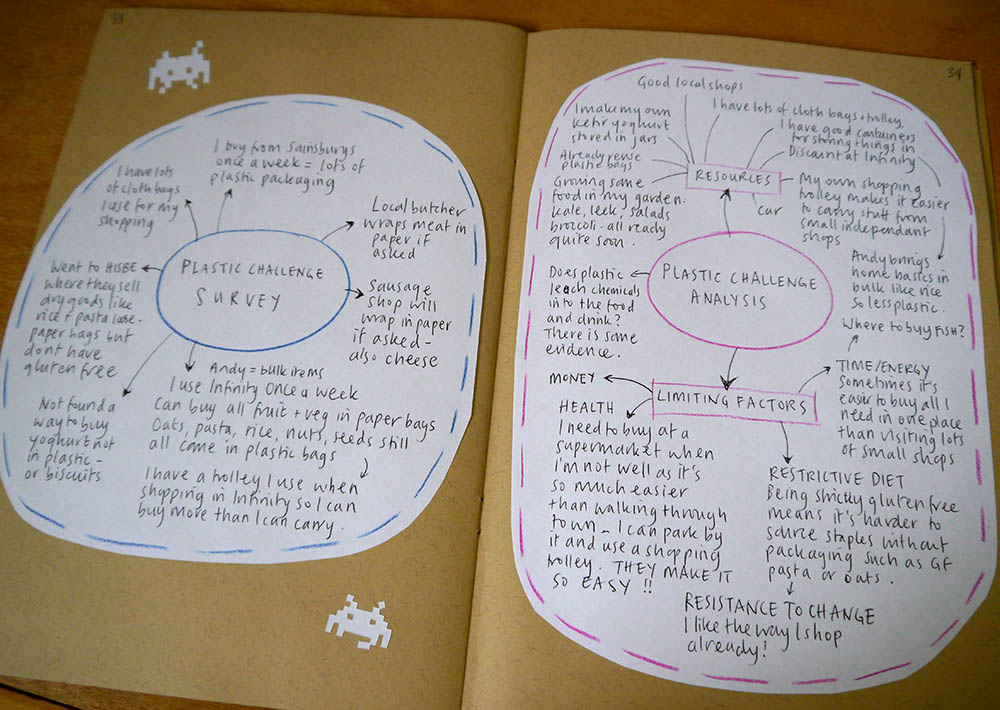 This has not been an easy challenge, and at times it has actually been a little stressful. I like to live as ethically as possible, but I also need to be as pragmatic as possible about shopping due to my health challenges. This has meant that my pragmatism has been bumping up against my attempt to go plastic free, meaning that I’ve had to avoid supermarkets (so easy, but so full of plastic!) and buy more from local small shops (not so easy when feeling unwell as it takes more energy). It’s also a rather budget-busting way of shopping too because small artisan food shops often charge more for their products. Another difficult part of the challenge is that they often don’t stock foods that I would normally rather buy organic (the dirty dozen includes potatoes, tomatoes and apples) so I’ve had to opt for local non-organic fruit and veg, which worries me that my health might suffer with an increase in pesticides in my diet.
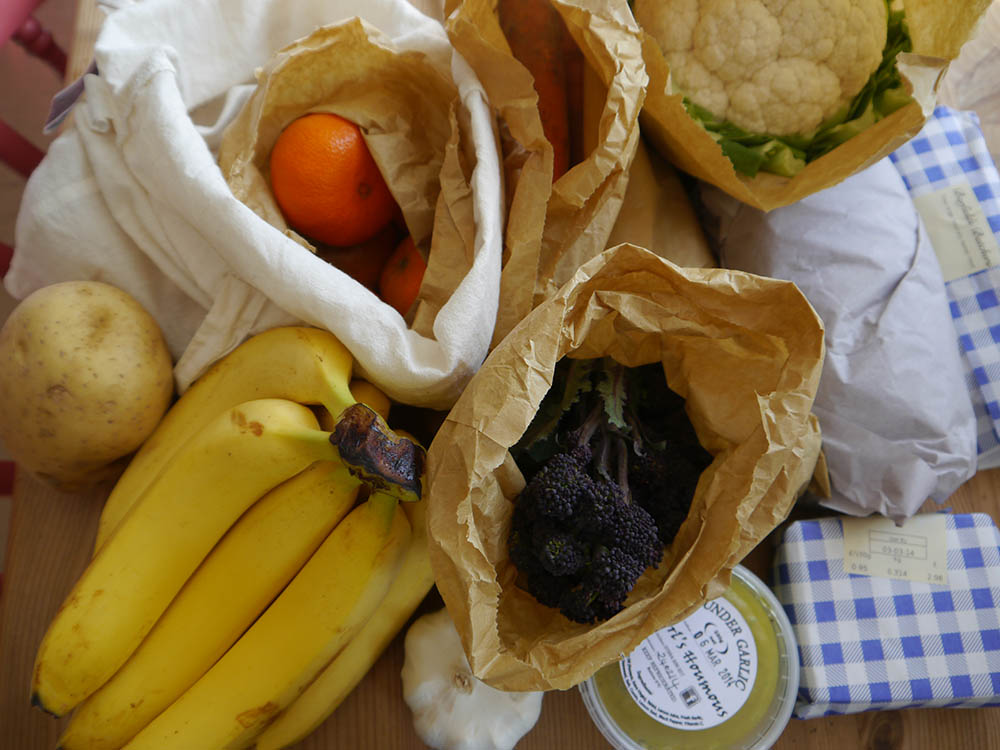
However, on the bright side, shopping at small local stores has been rather fun. I already know many of my local shop keepers and seeing them more regularly has kept the banter going (my local butcher has been taking quite an interest in my challenge and he seems to enjoy wrapping my cheese and meat in their blue chequered paper). It has to be said, there is a sense of satisfaction when buying things in paper bags and being able to compost the packages when they’re finished with. There is also some question as to whether some plastics leach into the foods, especially over a long shelf life, so it is gratifying to be avoiding this possible risk by using less plastic. It’s also rather pleasant to walk to a local shop, I’ve found that it reconnects me with my local neighbourhood and gets me to slow down a bit and notice things. In this way, walking can also fulfil others functions for me; gentle exercise and ecotherapy (I walk through woods and past front gardens). So it can be said that this change in buying habits has increased my quality of life.
 DESIGN PROCESS
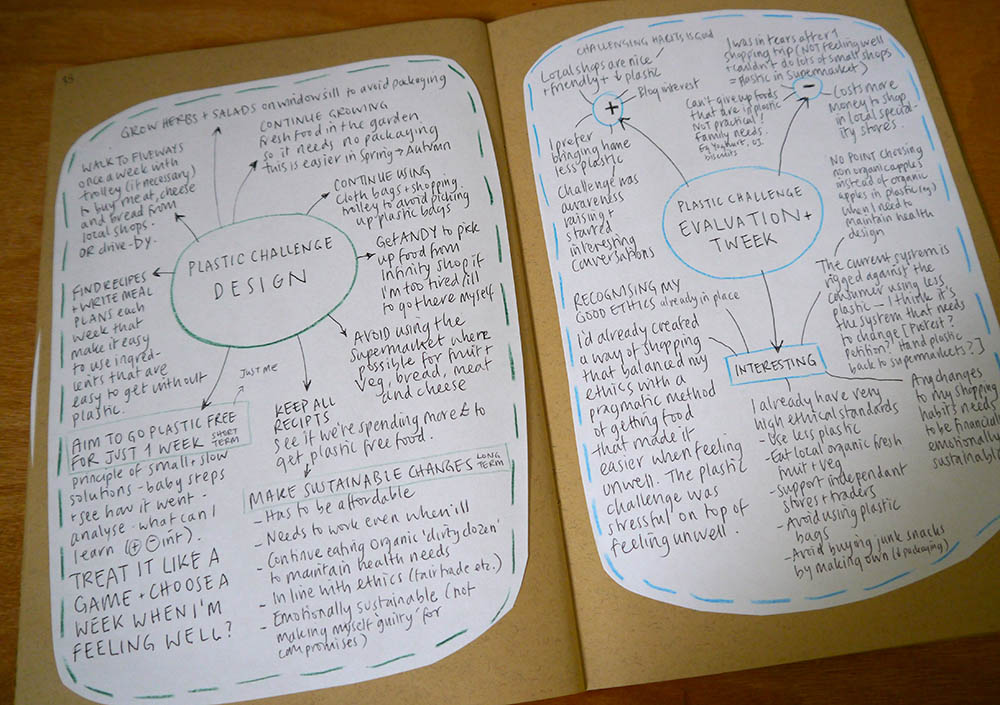
I began by reviewing the things I’d noticed, particularly the limiting factors; lack of time/energy, health concerns, restrictive diet, budget and resistance to change. These were all large limits on what I could achieve with this challenge, but I imagine that they might not add up to a lot more than many other people. Quite often people are either time poor, financially poor or health poor, whatever the limit, it’s not easy reducing our plastic waste when the system is rigged against us. Supermarkets make it so easy for the consumer to drive up, park for free, and buy large quantities of goods wrapped in plastic at seemingly discounted prices.
I found some things impossible to buy without plastic: I have no local fishmonger despite living only 3 miles from the sea, the only option was to go without fish, or buy it plastic. I can buy delicious locally made (just a mile away) artisan hummus at a reasonable cost, but it comes in a plastic pot. I could make it myself but this hummus is just so incredible that I’d struggle to replicate it at home. Despite making my own cakes and flapjacks for the family, my kids would go bonkers without a certain brand of chocolate biscuit that comes in plastic. I like to make my own kefir yoghurt but the kids don’t like it, so I buy them Yeo Valley yoghurt that comes in plastic pots. So I had to make a decision for the sake of this design. I decided that I would cut down on goods packaged in plastic that we can’t recycle, and continue to buy the goods that come in plastics that I can recycle.
 For me personally, I felt it was more important to create long term beneficial changes to my shopping habits, than it was to go all out for a total change that I could only sustain for a week or a month. The challenge I’d signed up for was ‘plastic free February’, but in order for my design to be meaningful in the long term , I would prefer to use a ‘small and slow solutions‘ approach.
DESIGN CRITERIA
1 It needs to be sustainable; it has to work even when I feel ill.
2 It has to be affordable.
3 I want to continue to avoid buying the ‘dirty dozen’ in order to maintain my health.
4 It has to be in line with my ethics of buying fair trade for example.
5 It needs to be emotionally sustainable; I need to be able to buy what I need without feeling guilty about buying the odd bit of plastic.
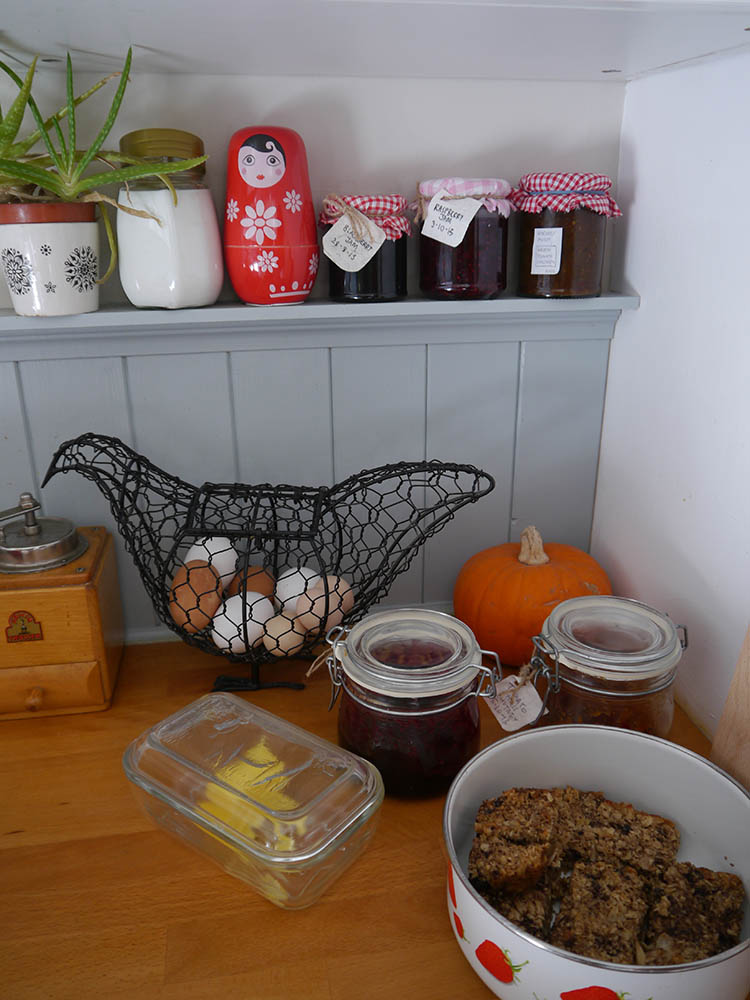
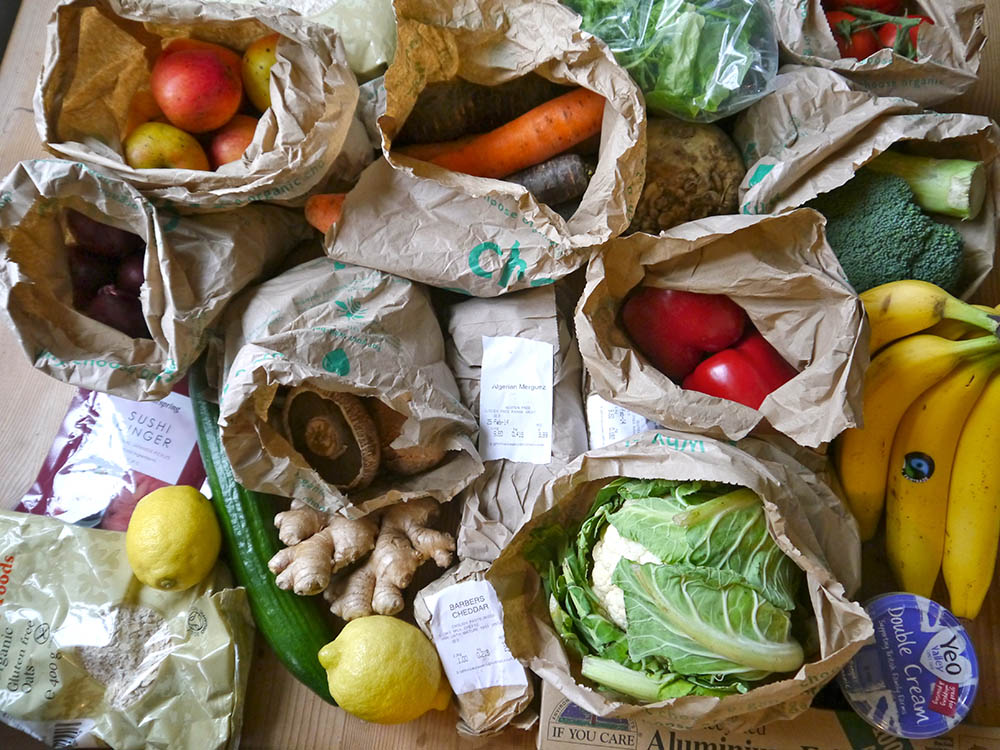
I found that a helpful start was to acknowledge how much packaging I already don’t buy. The image above is a corner of my kitchen where you can see my kefir yoghurt, home made jams and chutneys in recycled jars, home made flapjacks, and our own hens eggs. Making things at home saves packaging. I also use cloth bags when shopping, support independent stores and traders that sell fresh fruit and veg in paper bags, and avoid buying junk snacks. I felt I was already doing quite well at reducing waste.
 DESIGN SOLUTIONS
1 Continue to buy meat and cheese from my local butcher who I’ve now got a good plastic free relationship with and he’s happy to wrap things in paper for me, and avoid buying meat at the supermarket, except for fish.
2 Continue to buy bread from the local bakery in paper bags and avoid supermarket bread.
3 Buy some of our fruit and veg (as well as that delicious local hummus!) from my nearest local grocers, avoiding the ‘dirty dozen’ where possible, avoiding buying fruit and veg in plastic from the supermarket.
4 Buy fruit and veg from Infinity Foods where we get a staff discount and where we can buy all organic produce at affordable prices, in paper bags. My husband can pick up food from here during the week even when I’m not feeling well enough to go shopping.
5 Grow plenty of herbs and salads, fruit and veg in our garden at home, as well as keeping hens for eggs, to keep packaging to a minimum.
6 Keep making home made meals, cakes and biscuits to avoid buying these in plastic.
7 Use the supermarket without guilt when I need to, always remembering to take my cloth bags with me.
Before I go I’d like to share with you a picture of my lunch today. 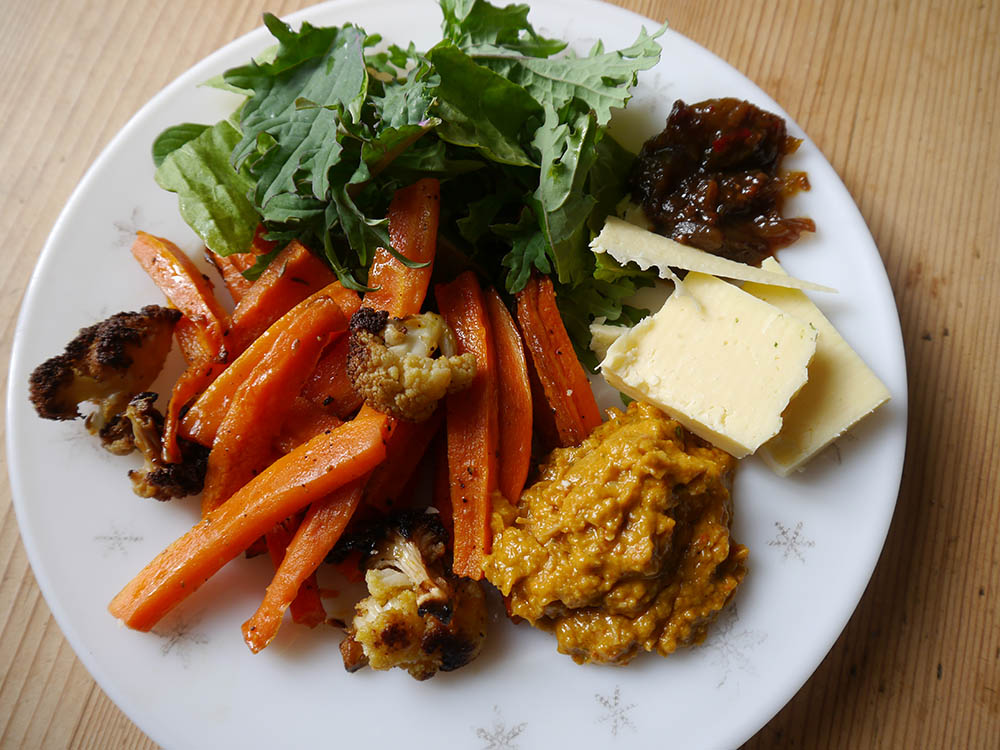 I had roast carrot and cauliflower (bought in paper bags from my local grocer), with salad leaves from my garden (corn salad, red russian kale and sorrel), with cheese (wrapped in paper from my local butcher) and chutney (home made), served with that delicious locally made hummus. It was really tasty!
These are all little steps towards a more plastic free lifestyle. Are there any steps that you have taken at home that you would like to share? Please do, either here or on my Facebook page.

6 Comments
Totally inspiring Flo, thank you. Going plastic free almost impossible here as few independent shops but I am now buying meat from a scottish organic farmer, an organic fruit and veg box which is mostly scottish, and am part of a food coop buying in bulk when possible. Unfortunately the bulk still often comes in plastic, as does the meat. All these options mean my visits to the supermarket have drastically reduced and most of our food is organic. I’ve had reactions because it is all delivered from other parts of scotland, which makes me smile, where do people think the stuff they buy in the “local” supermarket, comes from? Often a lot further away than the stuff I buy!
Thanks for the positive feedback Mairi. It sounds like you have your shopping sorted! And good point about supermarkets selling things with an incredible amount of food miles, many people don’t realise this.
Hi Flo,
Have commented on the FB page and I am leaving a request here! I have attempted a permaculture based design for our home school and would really appreciate it if you could take a peek and add any suggestions where necessary. I know you are a very busy lady and struggle with health issues so understand if this is not possible. I have linked to the blog in this comment heading so hopefully when you click on my name the link should appear!
Hope you are having a good day.
San xx
PS Your blog and the permaculture work you do is encouraging and inspirational. I have found an online 100 hours course that is accepted by permaculture UK and the course is based here in the UK.
Hey Flo
Your recent posts made me look at my kitchen habits and resulted in my making a terracotta pot fridge yesterday, and using my cool pantry for veg. It will be interesting to see how this goes-will mean a shift in some purchasing and hopefully less waste (putting leftovers into the fridge and forgetting about them)
Not sure if the pot fridge would be possible for family life, and I am a vegan so maybe fridge temperatures not so important without dairy etc.
Hi San, good to hear you have found a course that suits you. I found it so life expanding so I’m always pleased to hear of others taking that exciting road. I’ll see if I can take a look at your blog as soon as possible, it sounds interesting!
By the way have you seen the new *follow* button on my blog? I’m quite excited that people can sign up to receive my latest blog when I post them! Hope you are enjoying the Spring weather? It makes a change from the continual winter storms!!
Flo
Hey wow that sounds like a great step – my next door neighbour also uses a terracotta pot fridge and so long as you don’t have too much to keep cool it seems to work, especially at this time of the year. I think it does help that you are vegan so have no dairy or meat to think about keeping cool! I would love to design a house that has a ‘cold cupboard’ created at the north side of the house. My design would include a small walk in pantry, with a vent that allows cool air to sink into the space, with stone floor and shelves to hold the temperature low and steady. In medieval times the dairy used to be just like this with a stone floor that they’d pour water over, so the evaporation would draw off any heat and keep the space cool. They’ve got one at the Weald and Downland centre at Singleton; really worth a visit, it’s a great day out if you live near the south UK.
Flo