OBSERVATION IS THE KEY
While I was away this summer, I visited a couple of beautiful permaculture projects, one in Scotland and one in France. What was interesting is that I found myself having rather similar conversations about what permaculture is and what is isn’t. I’ve noticed that this seems to be one of the topics of discussion within the permaculture community at the moment, including in the letters pages of Permaculture Magazine (often involving comments from Patrick Whitefield) and in Facebook groups like ‘Permies‘.
 ‘Rhuba Phoil’ – or ‘Skye Forest garden’- located right by the ferry port at Armadale on the Isle of Skye, was the first project I visited with my family. We camped there right by the shore, with stunning views across the sea to the mainland.
What struck me immediately on entering the garden, was that it was clearly managed by someone with a very feminine ‘new paradigm’ way of thinking. What I mean by this is that it was immediately obvious that everything there, had been created by working with nature, and nothing had been imposed on the land that had not been negotiated with it first. No heavy machinery had been used in any of the 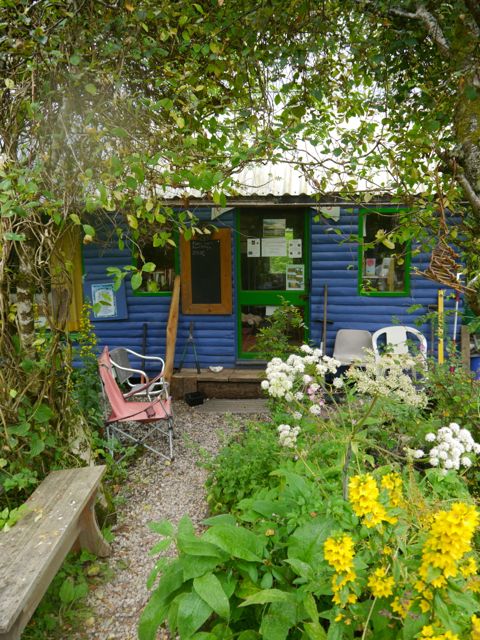 constructions, which were all built with recycled and natural materials. Notices told you about the benefit of weeds. Vegetables poked out from behind wild flowers and from under fruiting shrubs. Compost loos stood like wooden castles in the tree canopy. It was a very charming kind of organised chaos, that understood it’s place within the web of life.
I will write more about the garden in future blogs, but for now I want to talk about our discussion about what permaculture is and what is isn’t. Sandra, who founded and manages this Skye forest garden shared some of my concerns about the permaculture movement and where it’s going. She has had many ‘WWOOFers‘ visit her project, with the idea that they stay and help to manage and develop the garden. Often they’ll turn up with an idea about what they think permaculture is and persuade her to try out something they’ve recently learned about. An example of this was that they’d arrived all excited about the concept of ‘Hugelkultur’ beds, and then created one for her (see here and here for more info on this raised bed technique).
Now I’m sure that in the right place, in the right climate, after observing a need for a means to feed plants with slow releasing moisture and nutrients, a hugelkultur bed is probably a great solution. But in a sense this bed was ‘thrown’ at the landscape by a few excited enthusiasts who had not observed a need for it before imposing it on this particular patch of land. 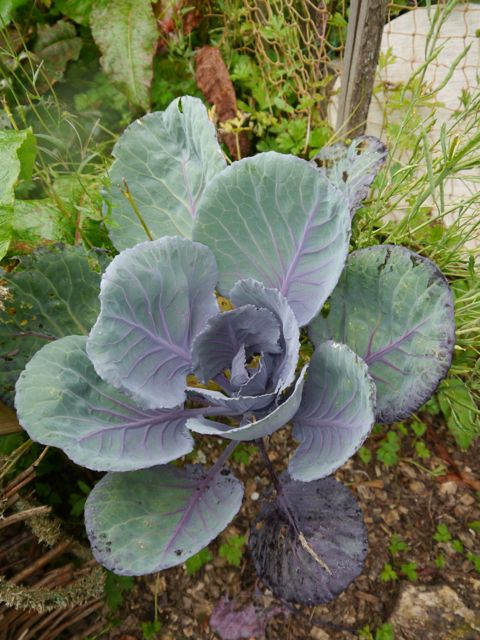 Sandra was worried that they had chosen the type of wood that would suck a lot of nitrogen out of the soil during it’s decomposition, actually making the bed very infertile. And on a rainy island like Skye there is little need for slow releasing moisture! She’d wisely decided to cover and leave it for a year and observe what it did.
In the new paradigm, we are not at war with nature, instead we work with nature. We understand ourselves as a part of the interconnectedness of life. We understand our sense of place within a complicated web of relationships. We first observe and later tweak what we find there. We do not wade in and impose our will on nature, even with the best intentions in the world, our hugelkultur bed might be disrupting a delicate balance that we might have noticed if we’d spent time first observing what was there. Observation is everything.
A ‘swale’ is another permaculture design idea that is as popular as the hugelkultur bed, and needs just as much caution in it’s implementation. In Patrick Whitefield’s post about ‘the death of the swale‘ he helpfully writes:
“For me the essence of permaculture is to tune in to the unique characteristics of a particular piece of land and of the people who are inhabiting or using that land. From this flows a design which will meet the needs of both land and people. It’s the very opposite of taking an idea off the shelf and saying, ‘Hey, this size fits all!’ ”
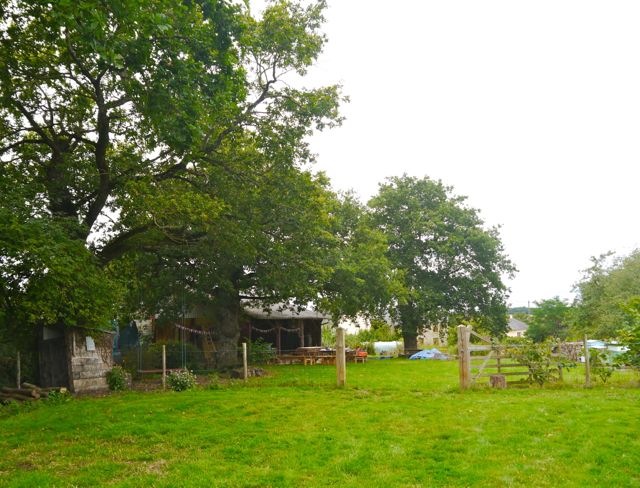 And this brings me to my visit to France where we spent time celebrating a birthday with Stuart and Gabrielle Anderson on their permaculture smallholding in Brittany. Around the fire one night, Stuart and I had this continuing discussion about what permaculture is and isn’t. I think we agreed that the principles of permaculture as set out by David Holmgren or Bill Mollison, are not there to be stuck to dogmatically, but are there as a guide.
For me, the permaculture principles are an essential roadmap for a mind that is still lost in it’s conditioning of the old paradigm of separation, and cannot yet see how everything is interconnected; they show the way to making the transition from the old mindset to the new one. But once you actually ‘get’ permaculture and you start seeing the world around you with new eyes, you can see how everything is connected in your landscape and community and you embody this symbiotic way of being. Rules or principles fade away as you develop your own deep relationship to your place in the web of life, that is essentially based on a firm foundation of good observation.
There is so much more I could say than I have time for in this blog, so I think I’ll be coming back to this over and over again. I am also fascinated about how this ties into another area that I’m interested in: how the old ‘at-war-with-nature’ mindset has created fertile ground for autoimmune disease and how transitioning to a new holistic mindset is the key to healing and recovery. Please feel free to comment here and on Facebook.

One Comment
It’s very true what you state about observation. In our permaculture proyect we know very well what this means. Southeast Spain is truly hard. In termomediterranean semiarid conditions not only observation is crucial. Also we have developed technical and scientific information in order to be successful in ecosystemic design. When water is scarce…an error in design can be fatal. We have a Facebook page dedicated to permaculture apart from our blog and a whole section for permaculture and ecosystem design in arid and semiarid conditions for Mediterranean climate: Permacultura Cartagena-Cuenca del Mar Menor. Greetings!