INCREDIBLE EDIBLE FRONT GARDENS!
 The most valuable lesson that my permaculture diploma taught me was that by applying permaculture design to anything in my life, I could measurably improve it and increase the ‘yield’ I got out of it. I learned that permaculture works. I would never have completed my diploma if I hadn’t learned this because I’d just been dealt a massive limiting factor; a diagnosis of Lupus. Permaculture taught me how to break things down into manageable steps and use my natural patterns of energy to get things done.
So my 10 designs included applying permaculture to all areas of my life; my health and wellbeing, how I organised my house, how I grew food in my garden, and increasing sustainability in my housing co-op. I needed just one more design to complete my diploma, and finally the inspiration came as I was on the bus home one day. Our bus route takes us through our local council estate in Hollingdean, Brighton, and as I stared out the window I observed how many large front gardens people had, all very under-used with mostly just grass growing there.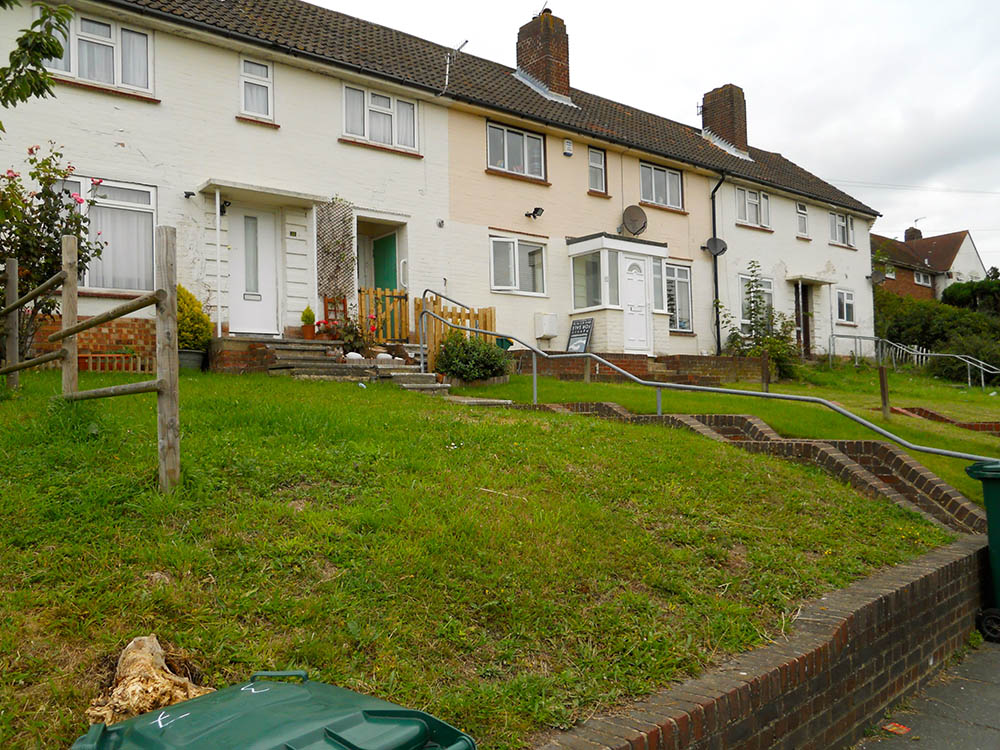 I’d also been noticing a lot of coverage in the media about how people were feeling the financial squeeze with all the benefit cuts, many having to make very difficult choices between eating OR putting the heating on. One particular article about child food poverty really struck me; how could children in a developed country like the UK be going without food?? This is insane!
I really wanted to do something to address these issues, so as I let my imagination wonder from the bus window I had a vision; could I help increase access to affordable healthy food, by encouraging a new culture of food growing in front gardens and green spaces throughout the estate? 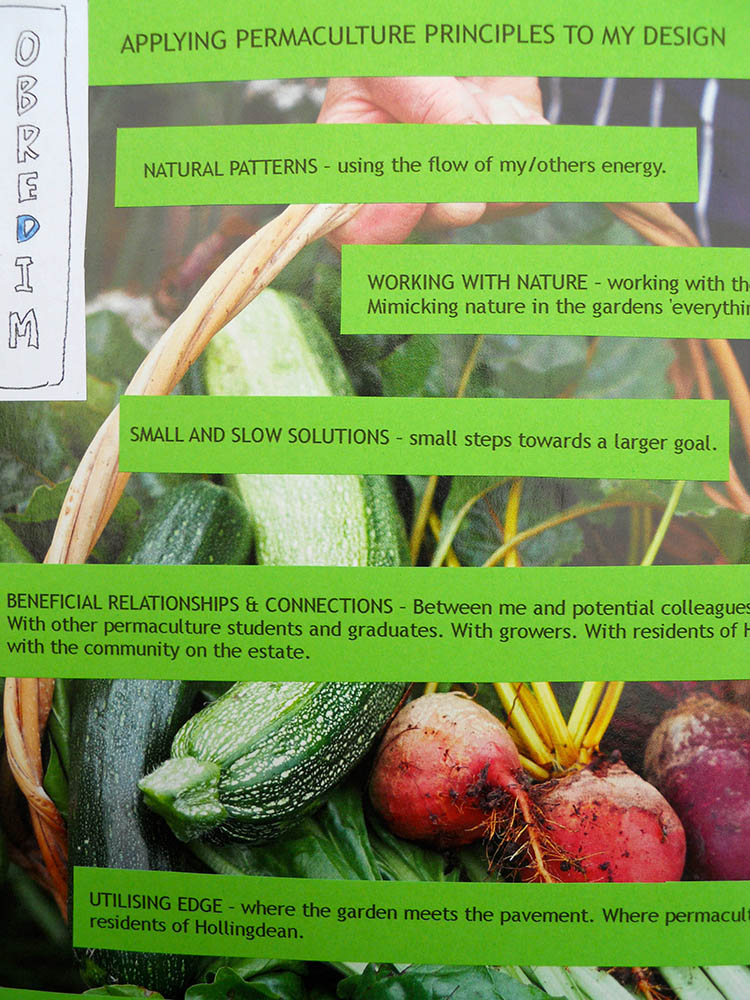 I had my doubts due to my health being so limiting; could I really take on such a big project on a community scale? I decided to put my doubts aside and go ahead and design a pathway to make this happen, using permaculture tools and principles to help me.
Using the principle of designing from patterns to detail, I designed a simple step by step flow-chart to help me plot my way to setting up the project, now called Real Food Hollingdean. 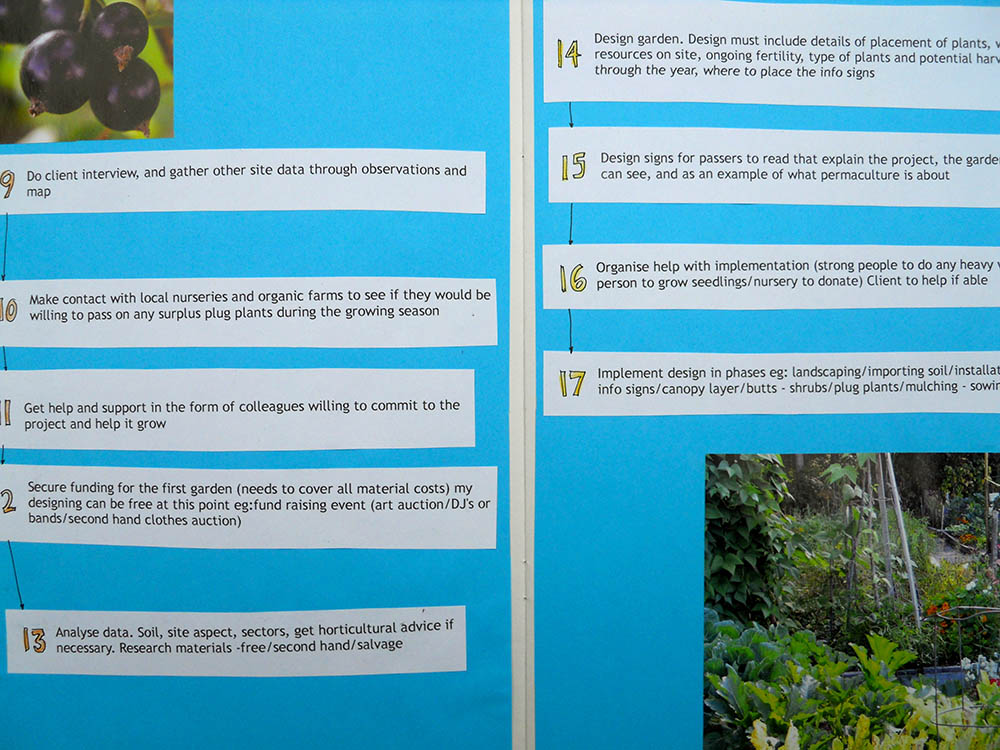 This had the magic effect of helping me to not see the whole project as a huge and overwhelming impossible mountain to climb. Instead I could just focus on each small step. I also designed in some allies to help me achieve my goal, asking for help from a good friend who was always on the end of the phone to offer moral support and advice, and who came with me to deliver our leaflets in our target area along the main bus route. I also invited Brighton Permaculture Trust (BPT) to be our project Partner, which really helped to add weight to our cause and to attract funding. Three members of BPT are now part of our management committee and one is also our project co-ordinator, and with their help and expertise of working on a community level, the project has leapt forward.
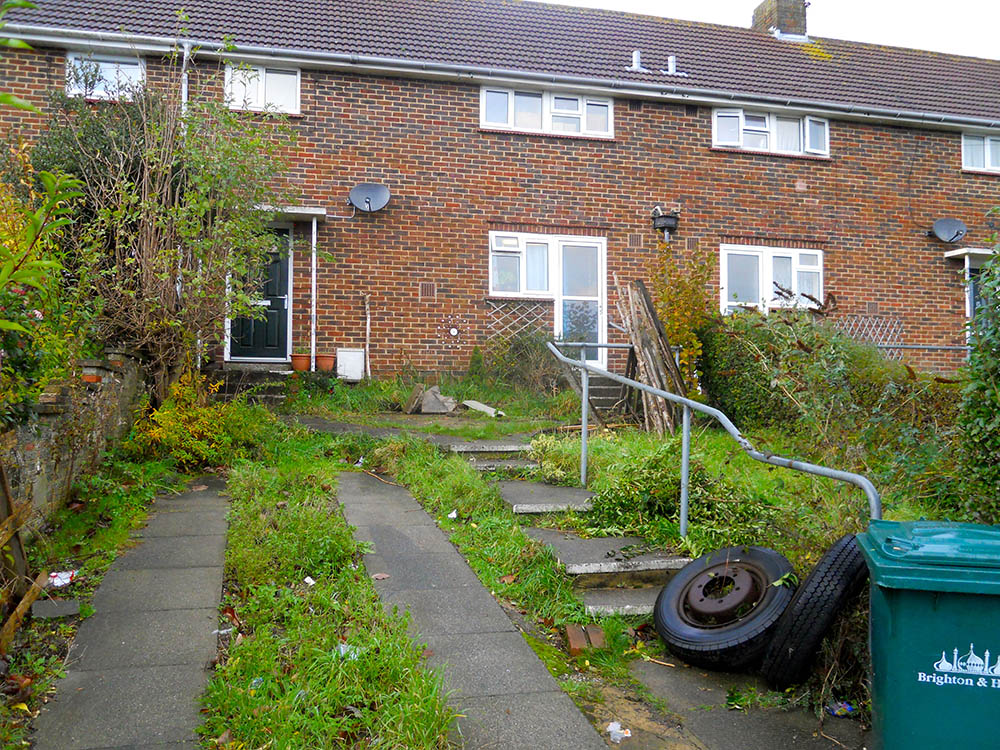 We had two households respond to our small leaflet drop in our target area. We interviewed them both, and decided which one would best suit our aims. The household we chose was a single mother, who showed a keen interest in learning about permaculture and growing food in her front garden, and who was comfortable with other people coming to the garden to learn too.
We then spent some time working together. We went through the various stages of permaculture design together, starting with the SURVEY stage; observing the garden and recording these in the form of photos and a base map. At the ANALYSIS 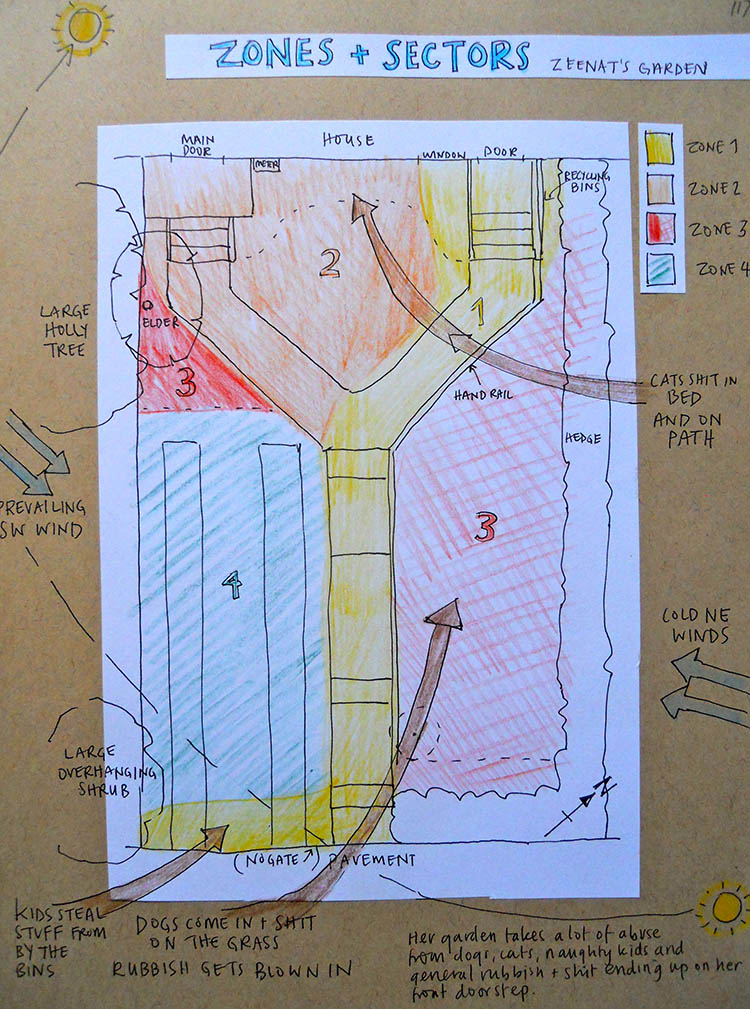 stage we looked at the observations and mapped out what we’d noticed. We looked at zoning (noticing which parts of the garden got the most attention), sectors (the things that influence the garden front the outside) and we looked at resources and limiting factors. We also used the tool ‘plus/minus/interesting’, where we created a mind-map of the things we’d noticed, to help us address these in the design process. Many of our sessions were recorded on film by an interested person who wanted to learn more about permaculture, and these little films may even turn up on Youtube in future!
At the DESIGN stage, I tried to create a design that would work for the household, and us as a project. The 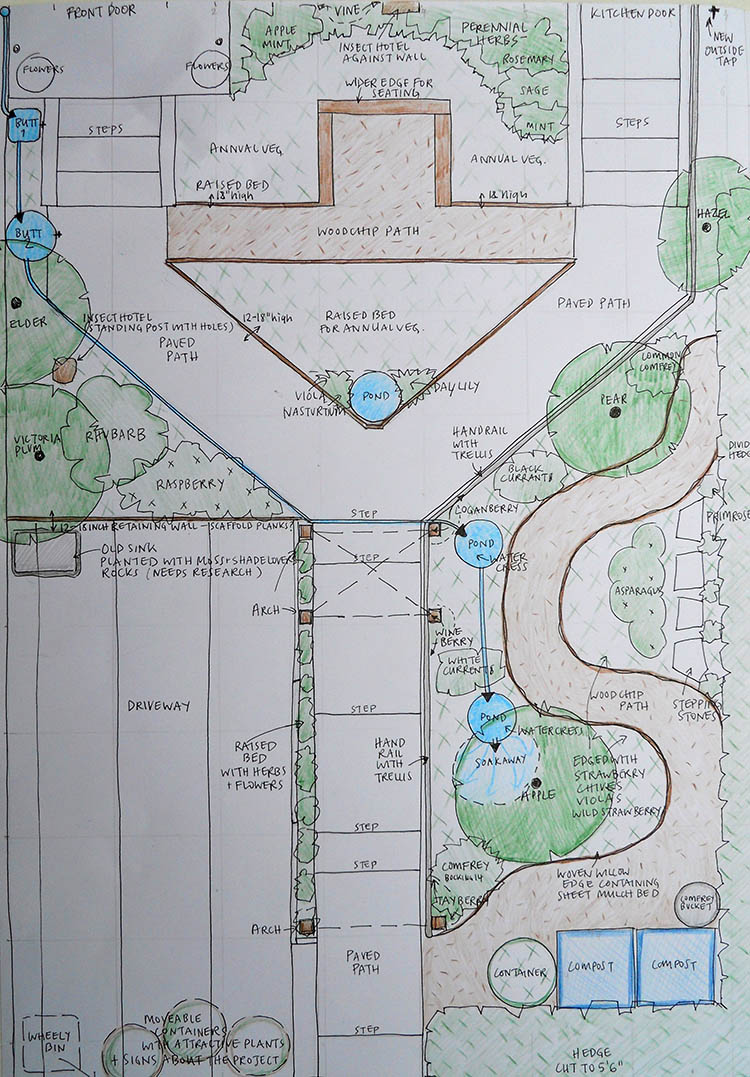 garden includes a perennial food forest in the zone that receives less attention, and raised beds near the doors for annual veg and herbs where they’d receive more attention. This design will hopefully be giving the household some fresh food all year round, including apples, pears, asparagus, rhubarb and lots of different soft fruits, as well as providing a varied and interesting array of plants for people to come and learn about.
Excitingly, we are now at the IMPLEMENTATION stage! We’ve had our launch, a successful event at the local community centre where I spoke about the history of the project, and our co-ordinator, Stephan Gehrels presented the garden design. Lots of people signed up to be volunteers and we had our first 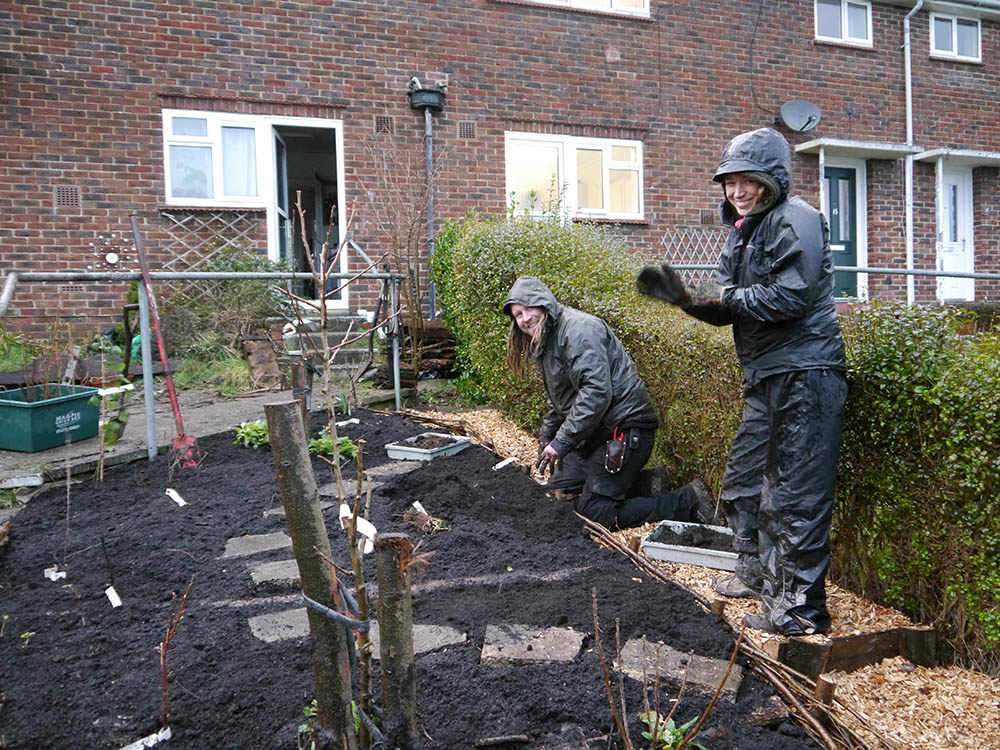 gardening session last Saturday. We were very fortunate that our volunteers were hardy souls who were not afraid of a few torrential hail storms!
We are now planning the next phase of gardening days and looking forward to seeing all the fruit trees and perennial plants that we planted coming to life in the Spring. We hope that all the passers by who saw what we are doing and stopped for a chat will also want to be part of this exciting project – perhaps it’s just the beginning for an incredible edible landscape in Hollingdean?!
So here I am, despite the odds against me I’ve achieved my goal of making a difference in my local community, using permaculture design to help me. So, if you are feeling overwhelmed by all the world’s problems, and want to find a way of making your own patch of the planet a little better, I would encourage you to have a look at permaculture design courses in your local area and go for it! It’s the best decision I ever made.

3 Comments
Marvellous Flo. Reslly interesting t o see how permaculturedesign has got you this far.
Thank you. Yes permaculture works! It’s such a fail-safe design system because it mimics natural systems, which obviously have evolved to survive and thrive. I think ultimately if enough people know about permaculture, we can design a future for all life on the planet to survive and thrive together. That’s the kind of future I want my children to inherit.
Well done, Flo! I can;t wait to see your projects as they develop–cheers!