GARDEN DESIGN STEP 1
In any good permaculture design, the very first step is always the SURVEY; it makes good sense to be making good observations first, before jumping in and imposing your design ideas onto a space, otherwise you might make costly mistakes that you regret later. So this blog today is about my observations so far.
My new house has a front and back garden, and so far I’ve observed it from early June and around the Summer Solstice, past the Autumn equinox and into late October.
FRONT GARDEN
At the front we have something that used to be a rockery; a north facing slope in a shady position, full of rocks and overgrown with grass. It only gets direct sunlight in early morning and in the evening in the summer months, while the rest of the time it only gets reflected light – as the sunshine bounces off the white terrace opposite us. It is exposed to the cold north-easterly winds in Winter, and during Altlantic weather coming in from the south-west, although it’s partly sheltered by the houses and the trees behind us, it is rather exposed to the wind rushing up the street.
On the other side of the steps leading up to our front door with have an overgrown boarder containing a rose bush, and a shrub with variegated leaves, with a ground cover layer of some kind of spreading plant that I am yet to identify – I doubt it’s edible otherwise I’d probably recognise it!
 BACK GARDEN
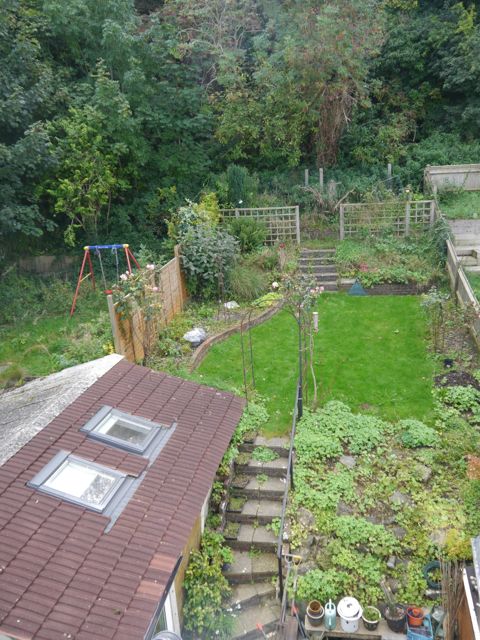
At the back we have a good aspect – south facing garden – but positioned on a north facing slope, and it is also overhung by trees. We’ve now been able to view the local Council’s plans to do maintenance work to the trees ,and we have realised that they will not be cutting any of the trees at the end of our garden. We were slightly disappointed that there would be no improvement to the light levels in our garden, but this means that at least we now know what we are dealing with!
We have observed that during south-westerly winds (that can be damaging) the trees do a great job of protecting our garden, and now as the Autumn plods on, the leaves are beginning to fall and the sun is shining through the branches. The garden still gets no direct sunlight, but sunshine does bounce off the house. During mid summer we observed that the sun gets high enough each morning to rise above the canopy and shine in the part of the garden that is nearest the house, and the rest gets direct sunlight all afternoon.
From these observations I now know that I need to be thinking about creating a garden that contains plants that love dappled and reflected light, and plants that don’t mind getting no direct sunlight all Winter. This is a completely new kind of garden from the one I had to work with in my old place, where I had a south facing garden that received direct sunshine every day of the year. I’ve had to do some research – and I was pleasantly surprised at the long list of plants that would be happy in my new garden. Here’s what I found:
EDIBLES FOR DEEP SHADE:
Mushrooms
Alpine strawberries
Mint
Hostas
Giant bellflower
EDIBLES FOR PARTIAL SHADE (dappled or bright indirect sunlight):
Asparagus
Bay
Beans
Beets
Blackberries (and all the other bramble berries) can be invasive
Black currants
Blueberries
Broccoli
Brussels sprouts
Carrots
Cauliflower
Celery – especially in areas with hot dry summers
Chard
Chinese cabbage
Chives & chinese chives
Cooking greens (collards, mustard greens, kale, pak choi)
Coriander
Cress
Cucumbers
Elderberry
Garlic
Giant bellflower (Campanula latifolia)
Gooseberry
Grapes
Horseradish (particularly good when planted under fruit trees because it repels fruit tree pests)
Kale
Leeks
Lettuce
Lovage
Micro greens (eg pea or fava bean shoots)
Mizuna
Musk mallow
Mustard Giant Red/Green in the Snow
Onions
Parsley
Parsnips
Pear (Conference)
Peas
Peppers (take longer to ripen)
Potatoes
Radishes
Raspberry (Autumn varieties)
Red Currants
Rhubarb
Roses (particularly Rosa rugosa, which has several shade tolerant varieties)
Salad greens (lettuce, spinach, wild rocket, endive, cress)
Spinach – especially in areas with hot dry summers
Spinach Beet
Strawberry (fruit may be smaller and not as brightly colored)
Sweet cicely (Myrrhis odorata)
Sweet potatoes
Wild Rocket
Wild garlic (Ransoms)
Wild leeks (Allium tricoccum)
I am also researching which medicinal plants I might be able to grow in my garden, as I use herbs to help me control some of the symptoms of Lupus. I’m also researching and recapping my ideas and knowledge about creating my garden with the no-dig method. I found some really helpful websites and blogs which I have added to my Facebook page here. Some of the best ones were:
LIVING WITH THE LAND PART5 – NO-DIG GARDENING (video)
HOW TO START A NO-DIG VEGETABLE GARDEN
5 ANTI-INFLAMMATORY HERBS IN YOUR BACK YARD
WHAT YOU CAN GROW IN SHADY SPACES
Do let me know if there’s anything you’ve grown successfully in similar conditions that you think should be on my shady list! Any advice and tips are welcome.

3 Comments
I have grown white strawberries in partial shade. I got the seed from the James Wong collection in the Suttons catalogue. They have fruited all summer long and are still going strong. The birds seem to do less damage than to the red varieties. They might be worth a try.
Not a medicinal herb but Sweet woodruff has proved to be a very useful ground cover plsnt in shade.
Good lick with your design and please keep posting.
Thanks Sue!
The white strawberries sound interesting, I’ll definitely look into getting those, perhaps the alpine variety? Always good to fool the birds too. And I’ll look up sweet woodruff too.
Flo
I’ve been told by a commenter on Facebook that Morello cherries do well in a north facing aspect, as well as Lungwort which is used in herbal medicine for treating the lungs, and Lady’s Mantle which is also used in herbal medicine but also provides some ground cover.
The list is growing!