THE CHICKEN GARDENERS
Last year I wrote an article for ‘Your Chickens’ magazine about my permaculture design for keeping chickens in my small garden. In case you missed the article (issued last October/November) I thought I would share it with you here. As you can see I had to write it in the third person:
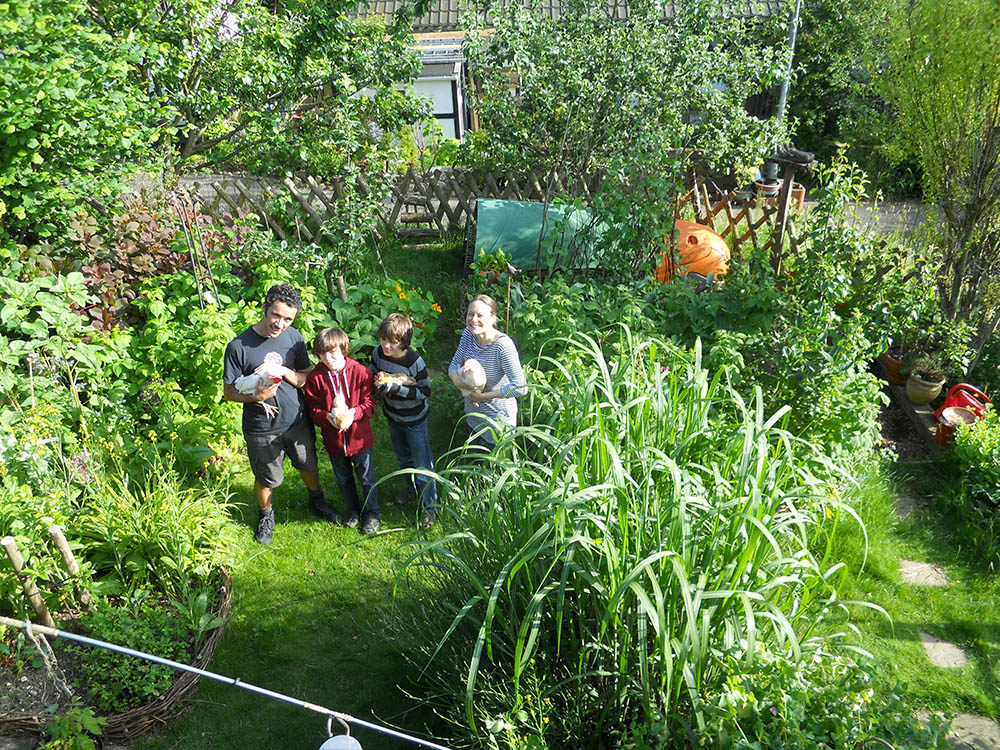 “Chickens love to scratch about but in a fairly undiscerning way, it has to be said: nibbling and uprooting prized plants, scattering seedlings and generally making a big mess. A family in Brighton with a 30x26ft garden, have developed a clever way to keep chickens happy in a small space while turning them from a hindrance into a help .
Flo and Andy, and their 13 year old twin boys live in a housing co-op, a group of small timber houses on the edge of Brighton. They had always wanted to keep chickens but were too nervous to take the plunge. However, in early 2009, when moving house, a friend had to give up her 2 Serama bantam hens, forcing Flo and Andy to make a quick decision to adopt them. The hens, called Daphne and Brenda, quickly became part of the family. “They’ve brought so much life to our small garden and given us so much fun, that we’ve never regretted saying ‘yes’” Flo told us.
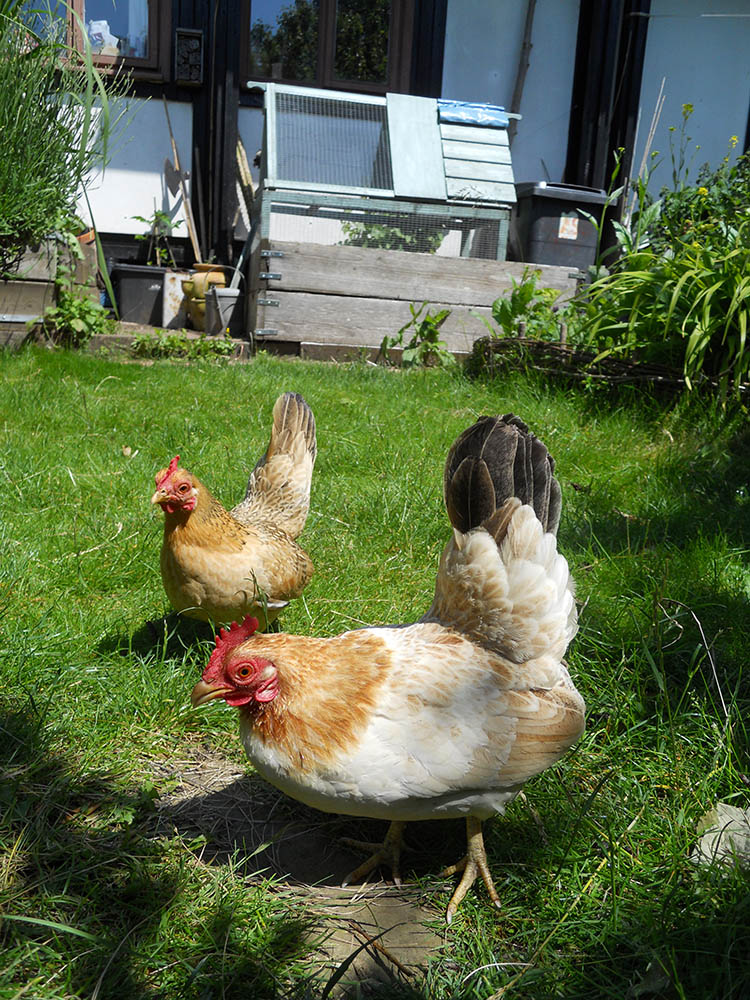 Although they seemed comfortable in their Eglu and 2m run, they were often let out to free-range. “It wasn’t long before they got stuck in, scratching the soil and kicking it onto the lawn, creating a right mess of our tiny garden,” Andy recounts. “They also jumped onto our two raised beds and dug up and ate the seedlings whenever my back was turned!” adds Flo. Being bantams, Daphne and Brenda were not prolific layers, and often went broody, tricky to manage when there was only one nest in the Eglu.
Flo was learning about permaculture—a design system for ecological living—and realised that she could use this approach to design a better way to accommodate their lively bantams in a tiny garden. It would make best use of the chickens’ natural behaviour, while cutting down on the mess they made. The solution: a ‘chicken tractor’ and correspondingly-sized veg beds. “I know the name conjures a mental image of chickens pulling a tractor like feathered oxen,” jokes Flo, “but it’s a really simple system of containing the chickens inside a specific area, to concentrate their natural behaviour to where we want it most.”
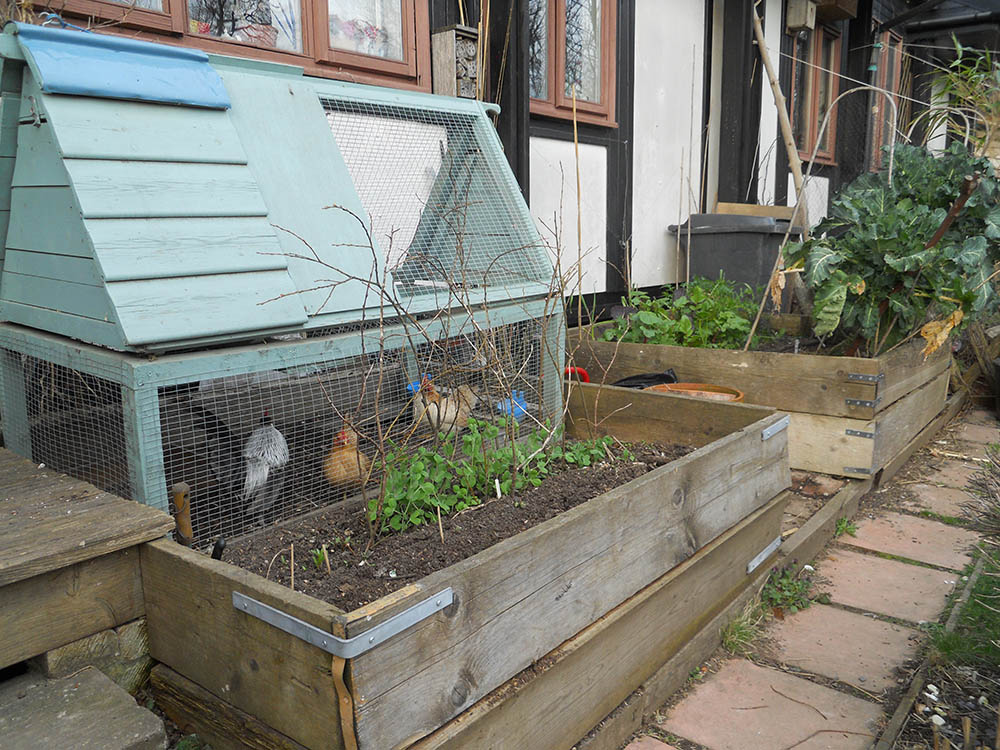 Their chicken tractor was created from a basic Forsham Ark, which they mounted on top of a home-made sturdy chicken wired frame, to create a double-height space with perching places, upper nest box and run below. The run’s footprint takes up exactly half of a raised bed. It can be moved to 4 different positions on the 2 beds, so that it always sits on the fallow bed in rotation with 3 vegetable crops. The hens happily eat pests, scratch up the soil into a nice crumbly tilth and manure it, ready for the next planting of seedlings, while the food crops in adjacent beds are safe from unwelcome attention.
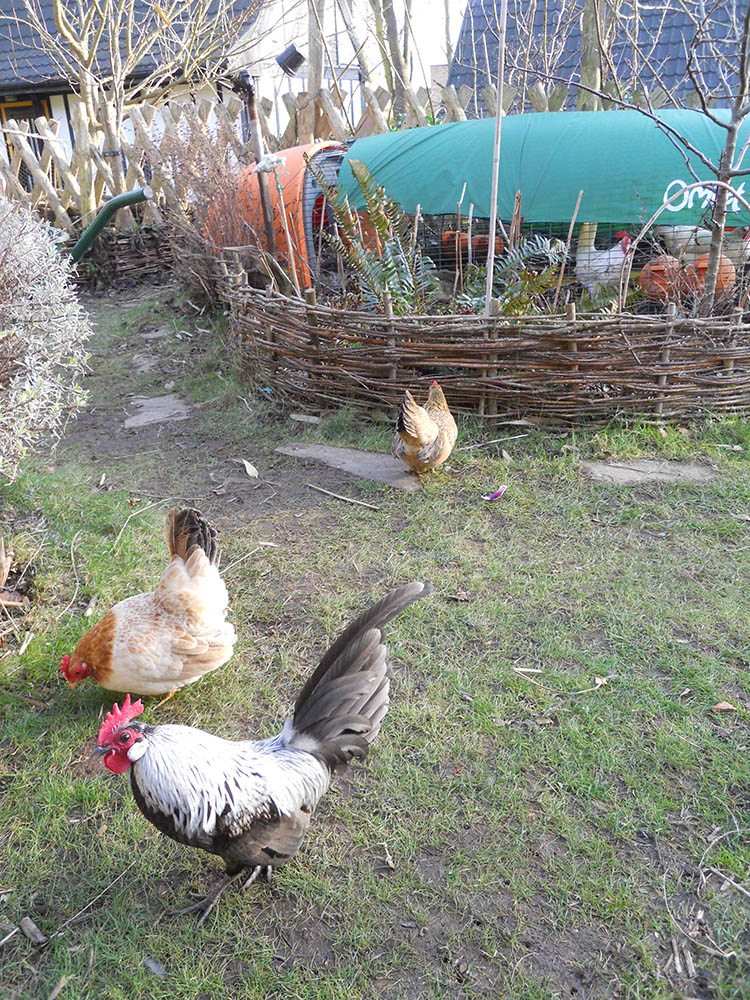 Brenda and Daphne were then joined by Charlie, a beautiful Ardenner bantam Cockerel rescued from a local farm by Andy, who took pity when he found that Charlie was due for the chop that day! “We promised to be very kind to the neighbours and agreed to only let Charlie and his girls out after 8am each day so as to not create too much noise” Andy told us. Charlie quickly settled in, and behaved like a true gentleman, always letting Brenda and Daphne eat before him, and announcing loudly when any egg laying occured!
However, while Charlie was loved by many of the neighbours, he became rather unpopular with the couple opposite after they had their first baby! “We’d always said to the neighbours that if noise ever became a problem, we’d get Charlie re-homed” explains Andy. After a few enquiries, the perfect solution presented itself: Charlie went to live with a loving family, who live in a very rural location in Sussex, where he’s free to roam and roost with the other Bantams in the trees and crow to his heart’s content!
 With the bantams now occupying the tractor, and the Scott family growing in chicken-keeping confidence, the vacant Eglu was soon filled by two beautiful large white laying hens, Lily (a Leghorn) and Vera (a Light Sussex). They are consistent layers, so the family now enjoy a reliable supply of eggs.
Both flocks have their own dust bathing area, and as the Eglu is static, Lily and Vera get plenty of woodchip to scratch around in. The bantams enjoy their smorgasbord of invertebrates but struggle with the larger slugs and snails, so they are picked up and given to Lily and Vera who gobble them up enthusiastically.
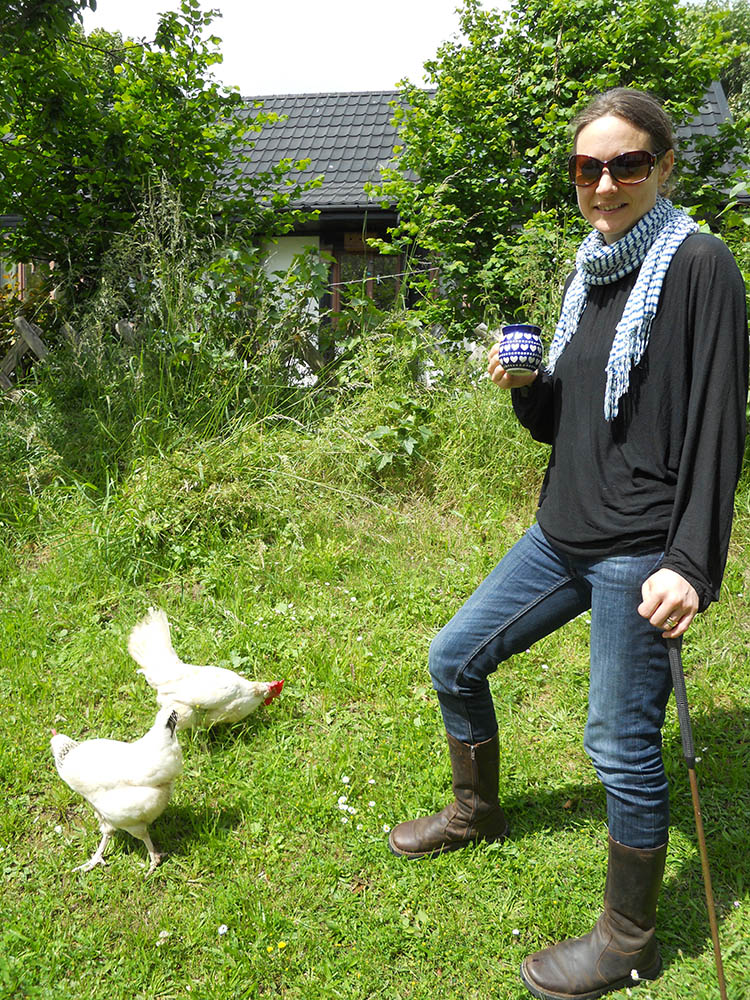
Free ranging is still permitted under close supervision, and the larger hens are also let out of the garden into the communal green space in the middle of the co-op. “We have to be careful of dogs that occasionally run through here,” explains Flo “so I am often seen guarding the hens like a kind of Chicken-Shepherdess!”
Their experience has shown them that, with good planning, it’s possible to keep chickens in a small garden while keeping the garden productive and beautiful, and having lots of eggs from very happy chickens. ”
For the next instalment of the story about my chickens in my small garden, please look out for my next blog, where I will talk about how we had to tweak the design in order to deal with a new problem, and how this tweak led to making the chickens system work even better for us.

4 Comments
ls a very lovely garden and keep it up my name is sanusi from nigeria,with a vision and mission to be a permaculturalist
Hi,
I am a lupus patient also and enjoyed reading your article on how you learned to manage your energy and life. I am starting that part of my life now. I realized that moving to a more suitable area and home is important to my life though my love one’s prefer not to.
Have you written a book on the steps you taken to find balance in your energy and stress levels? I would be interest in such a frantic and illustrated source of information.
Thank you for sharing your knowledge,
Bridget
Hi Bridget
I’m really pleased you found the article helpful. Sorry to hear you also have Lupus, it’s such a tricky disease to manage isn’t it? It sounds as though you are making progress with designing your life in order to manage your health better, it’s not always easy when loved ones don’t ‘get it’. Clear boundaries and communication are valuable tools! It’s so important that you put your health first, it’s impossible to help others in a sustainable (ongoing) way unless you are well yourself, so paying attention to ourselves and our own needs ultimately benefits everyone.
I am considering writing a book jointly with a clinical psychologist about this subject and will keep you posted on this via my website and Facebook page (see link on home page).
Do keep taking small and considered steps in a positive direction and you’ll notice over time how your life grows into a positive place.
All the best
Flo
Hi Sanusi
So lovely to hear from you -all the way from Nigeria!
I’m glad you like my garden, I love it too! It’s so nurturing to be able to work with the soil and watch things grow.
Do stay in touch through my website -and I also post a lot of information about permaculture on my Facebook page (see link on the box on the left) so if you can, join Facebook and ‘like’ my page and then you can access all this useful info from all over the world.
All the best
Flo